
In the previous articles, we've talked about various aspects of forest tea. Today, let's discuss a topic that everyone cares about most and can't avoid: Why is forest tea so expensive?
To be honest, as a tea seller myself, I often get asked this question. Some say forest tea is hype, a gimmick, or a way to harvest IQ tax. I don't want to argue; I'll just do the math for you—from the tea mountain to your cup, what does a piece of forest tea go through, and where does the money go?
First, Let's Calculate the Costs: Where Does the Money for Real Forest Tea Go?
Tea Mountain Management Costs
You might think that tea trees on the mountain don't need management and just grow naturally. That's true, but not entirely.
Forest tea gardens indeed don't need fertilization or pesticides, but they need protection. You have to prevent others from cutting down trees, prevent mountain fires, and prevent people from the surrounding areas from crossing the boundary to pick. These tasks seem simple, but they require people to stay on-site year-round and patrol the mountain. A few thousand yuan per month for forest protection fees is unavoidable.
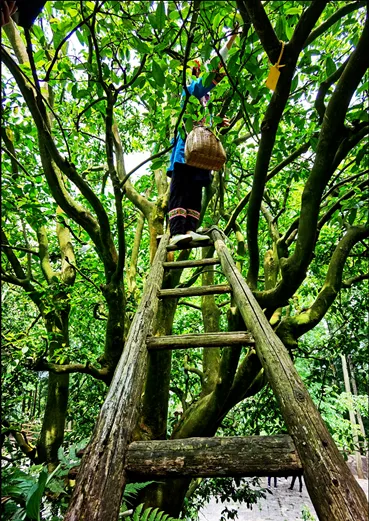
Forest tea that is difficult to pick
Picking Costs
This is the biggest expense.
Forest tea trees are tall and grow on steep slopes, some even on cliff edges. Pickers have to climb up, and in some places, they need to set up scaffolding. A person can only pick a few kilograms of fresh leaves a day—for terrace tea, a person can pick dozens of kilograms a day, but for forest tea, picking three to five kilograms a day is already good.
Moreover, pickers need experience to know which buds and leaves to pick and which to leave. Such skilled workers command much higher wages than ordinary tea pickers.
Transportation Costs
You might not have thought of this.
Forest tea gardens are inaccessible by vehicle, so the picked fresh leaves have to be carried out on people's backs. The mountain path takes two to three hours, and the fresh leaves cannot be pressed or suffocated; they must be placed in breathable bamboo baskets and carefully brought out. By the time they reach the initial processing facility, it's already dark.
Carrying a load of tea out incurs labor and time costs that all have to be factored in.
Production Costs
Forest tea has high-quality fresh leaves, but it's more labor-intensive to process.
During fixation (kill-green), the heat must be more precise; during rolling, the pressure must be more careful; during sun-drying, you have to guard against rain—every step is more meticulous than making ordinary tea. Many tea masters I know can process one to two hundred kilograms of fresh leaves a day for ordinary tea, but for forest tea, they only do fifty to sixty kilograms a day, prioritizing quality over quantity.
Then, Let's Talk About Scarcity: Forest Tea Is Truly Rare
The above are all costs, but price isn't determined solely by cost; it also depends on supply and demand.
How many real forest tea gardens are there? I've visited many tea mountains in Yunnan, and those that can truly be called "forest tea" are extremely rare. Three conditions must be met: the primary forest is well-preserved, the tea trees are of the group species (qun ti zhong), and the area is far from human habitation with year-round guardianship—such places are few and far between in all of Yunnan.
Production is even more limited. A true forest tea garden produces only one spring harvest per year, yielding just dozens to hundreds of kilograms. That amount, when placed in the national market, doesn't even make a splash.
When something is rare, it becomes precious—this saying never goes out of style.
Laosen's Fair Statement: Expensive Has Its Reasons, but Expensive Also Has Its Inflated Parts
Having said all this, I'm not trying to whitewash all high-priced teas. I admit that there are indeed forest teas on the market with excessive hype and inflated prices.
Some tea merchants repackage ordinary tea, fabricate a story, and sell it at several times or even dozens of times the price. This phenomenon exists everywhere, not just in the forest tea category.
So I don't advise you to blindly chase high prices. Price is not the only criterion for measuring good tea, nor is it even the most important one.
If a tea is truly forest tea, truly ancient tree, truly handmade, and truly free of pesticide residues—then its high price is reasonable because the costs are there, and the production is limited.
But if a tea has beautiful packaging, a good story, and an outrageous price, yet cannot provide any evidence of its origin and ecology—then you should be cautious.
Laosen's Advice for You
When buying forest tea, don't just look at the price or listen to the story. Ask yourself a few questions:
- Can the origin of this tea be clearly stated? The specific state-owned forest, the specific mountain, the specific plot—the more specific, the better.
- Can the seller tell you the picking time and production process of this tea? True tea makers can clearly explain the ins and outs of every tea they sell.
- Do you think it tastes good when you drink it? The last point is also the most important—don't be led by price and stories; trust your palate, not your ears.
For tea that truly deserves its price, you'll know where the value lies once you drink it. For tea that isn't worth the price, even if the packaging is heavenly, your palate won't deceive you.

Paragraph comments 0 · moderated
Comments 0 · moderated