
In previous articles, we've discussed various aspects of forest tea. Today, let's tackle a question many people find confusing: What exactly is the relationship between forest tea and mountain origins?
Some think forest tea is just tea from a specific mountain, others say forest tea is a step above mountain tea, and some use the two terms interchangeably, leaving everyone scratching their heads. Today, Laosen will set the record straight.
First, Mountain Origins: What Does "Mountain Tea" Mean?
The concept of mountain tea, simply put, is tea named after its place of origin. For example, "Laobanzhang," "Bingdao," "Yiwu," and "Yibang" all indicate where the tea comes from.
The core logic of mountain tea is: Different places produce different flavors. This is called "one mountain, one flavor."
Laobanzhang tea is bold, Bingdao tea has a rock-sugar sweetness, Yiwu tea is fragrant and smooth—this is the "character" that the mountain imparts to the tea. A true Pu'er enthusiast can identify the mountain by tasting, relying on this "mountain flavor."
Now, Forest Tea: A Different Dimension from Mountain Origins
Forest tea and mountain tea are not parallel concepts; they intersect.
Mountain tea refers to geographical origin—the name of the place.
Forest tea refers to growing environment—the ecosystem in which the tea trees grow.
Let me give you an analogy to make it clear:
- Mountain is the "house"—which neighborhood, which street the house is on.
- Forest is the "interior decoration"—whether the house is comfortable and the environment is good.
Tea from the same mountain can be forest tea or not. For example, in Yiwu's Guafengzhai, some tea trees grow in the primeval forest—that's forest tea; but tea from the same Guafengzhai that grows near the village with heavy human intervention cannot be called forest tea.
Conversely: Forest tea is not limited to a single mountain. As long as tea trees grow in a primeval forest ecosystem, whether in Yiwu, Yibang, or other tea regions, they can be called forest tea.
So the Question Arises: Which Matters More, Mountain or Forest?
Many tea enthusiasts struggle with this: When buying tea, should you look at the mountain or the forest?
My view is: Both are important, but "forest" is the more fundamental standard.
Why? Because the mountain determines flavor characteristics, while the forest determines the quality baseline.
When you buy forest tea, regardless of which mountain it comes from, at the very least it has good ecology, is clean, free of pesticides, and rich in internal substances—this is the guarantee provided by the forest environment.
But when you buy mountain tea, it's not always the case. Even with Laobanzhang, there are ancient trees, small trees, terrace-grown trees, and even adulterated products. No matter how famous the mountain name, if the tea trees grow in a poor ecological environment, the quality of the tea won't be high.
In other words: Forest tea is above the "passing line," while mountain tea differs in "characteristics."
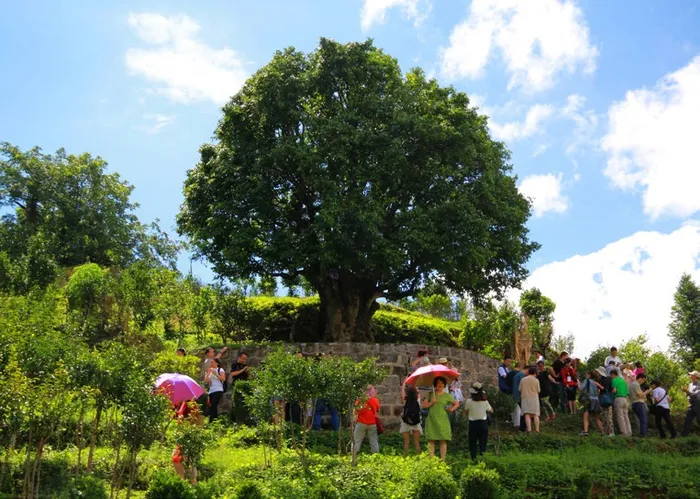
Ancient tea tree with many visitors
Laosen's Experience Visiting Mountains
Over the years, I've visited many mountains, and I'd like to share some insights.
True forest tea is often not found on the most famous mountains. Famous mountains attract crowds, vehicles, and heavy intervention, which more or less damages the ecology around the tea trees. In contrast, places that are hard to reach and rarely visited have better-preserved forests, and the tea trees live more freely.
So when I select tea, I don't just look at the mountain name; I look at the state of the forest. If the forest is alive, the tea trees are alive; if the forest is dead, a famous mountain name is useless.
To Make It Clear for You
The relationship between forest tea and mountain origins can be summed up in three sentences:
- Mountain is a geographical label; forest is an ecological standard.
- Tea from any mountain, as long as it meets the standards of forest ecology, is forest tea.
- When buying tea, first check if it's forest tea (to ensure quality baseline), then check the mountain (to choose the flavor you prefer).
Don't let complicated explanations confuse you. Tea, at its core, is: Tea trees grown in a good environment produce good tea. As for which mountain it's from, that's just icing on the cake.
First pass the "forest" test, then talk about the mountain. That's the most important thing I want to tell you after over twenty years of visiting tea mountains.

Paragraph comments 0 · moderated
Comments 0 · moderated