
In previous articles, we talked about what truly is forest tea, how to distinguish it, and why it's good. Today, let's take a step further—how is forest tea made? And how should you store it after buying?
If you don't understand these two questions, even the best forest tea in your hands will be wasted.
First, Let's Talk About Processing: Forest Tea Isn't Just Stir-Fried Any Which Way
Some tea enthusiasts think that because forest tea has good raw materials, it will taste good no matter how it's made. This idea has ruined many good tea leaves.
Let me tell you, the better the raw materials, the more it tests your skill. Just like the finest delicacies, if given to a cook who doesn't know how to cook, they can ruin them.
The processing of forest tea has several key points, let me share them with you:
Picking: Not Every Bud Is Picked
Forest tea sprouts late, about half a month later than terrace tea. Some tea farmers get anxious and pick as soon as buds appear, but that's not right. You have to wait until the buds and leaves reach about 70-80% maturity before picking—if too tender, the tea liquor is thin; if too old, the taste is coarse.
Another point: when picking forest tea, you need to leave leaves on the tree. You can't strip it clean like picking terrace tea; you need to leave some leaves for photosynthesis. The tea trees in the forest are alive, so you have to let them keep growing.
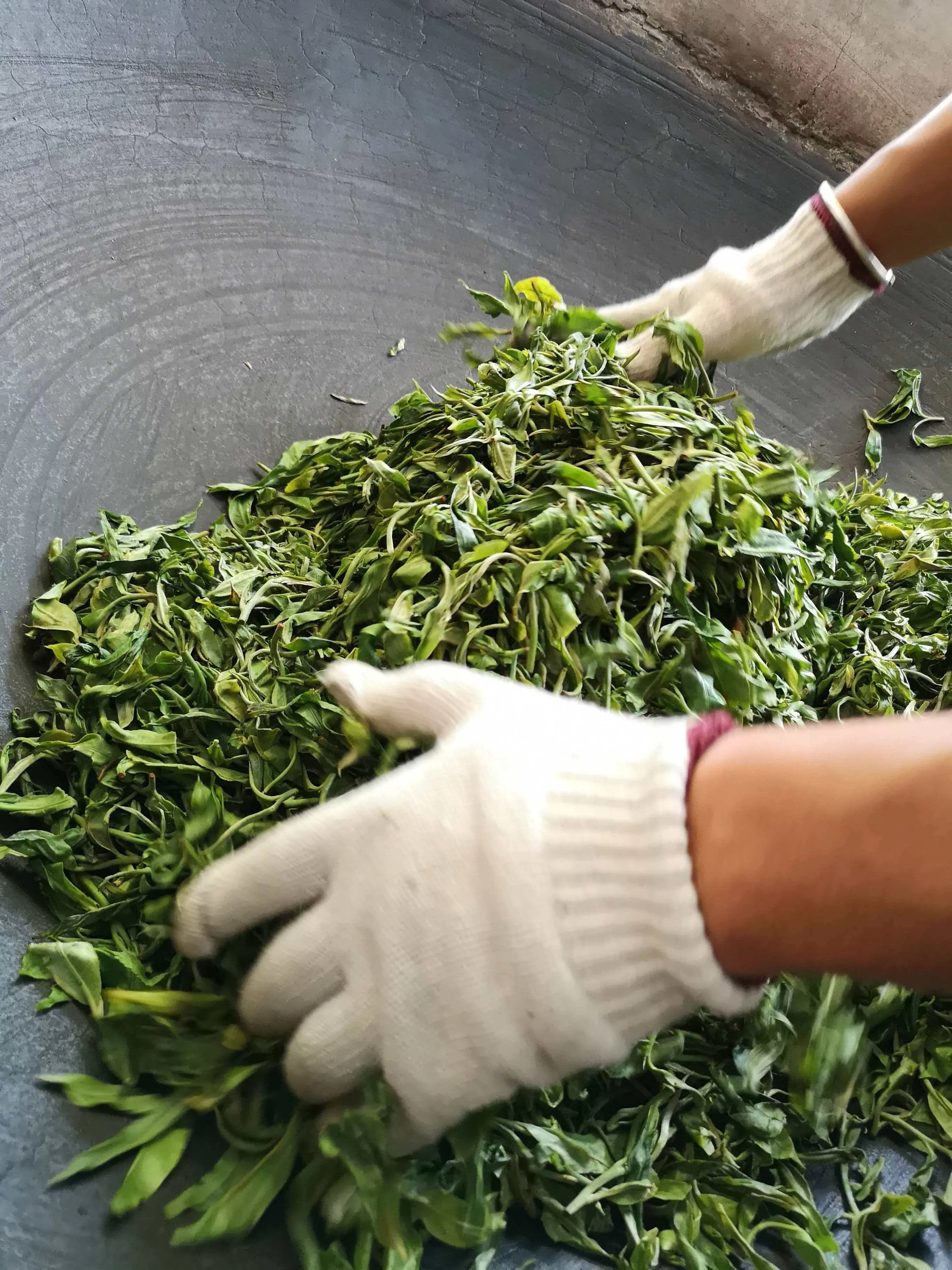
During stir-frying
Fixation (Sha Qing): Heat Control Is the Lifeline
Fixation is the lifeline of Pu-erh tea. Wok temperature, amount of leaves, stir-frying speed, duration—every variable affects the final aroma and taste.
The fresh leaves of forest tea have different moisture content and are much thicker than terrace tea. During fixation, the temperature should be slightly higher than for terrace tea, and the time a bit longer, to thoroughly eliminate the raw green smell and bring out the aroma.
Many ruined forest teas have problems in fixation—either not fixed enough, leaving a raw green taste, or over-fixed, causing the leaves to scorch and produce a smoky flavor when brewed.
I've been making tea for over twenty years, and in the first three years, I burned many batches of leaves during fixation. There's no shortcut to this craft; it's just practice over and over.
Rolling: Too Light or Too Heavy Won't Do
Rolling shapes the leaves and breaks down cell walls, allowing the tea juice to release slowly during brewing.
Forest tea leaves have high pectin content, making them sticky during rolling. If rolled too lightly, the cell walls aren't broken enough, and the tea liquor is weak; if too heavily, the leaves break, and the tea liquor becomes cloudy.
Good rolling leaves the leaves in a state of "broken but not crushed"—when you squeeze them, the juice comes out, but the leaves remain intact.
Next, Let's Talk About Storage: Well-Stored Forest Tea Is a Treasure
Once the forest tea is made, the work isn't over. How you store it directly determines whether you'll drink a "treasure" or "grass" years later.
Don't Store It with Random Things
Tea absorbs odors—everyone knows this. But I've seen people store Pu-erh tea with camphor wood boxes or in the same room as spices—the tea ends up tasting like mothballs or Sichuan pepper. What's the point of drinking that?
Forest tea should be stored separately, away from odors—that's the bottom line.
Temperature and Humidity Should Be Stable, but Not Stuffy
Pu-erh tea storage requires some humidity to allow the tea to continue "living" and fermenting. But if humidity is too high, the tea will mold.
When I store tea in Yunnan, I emphasize natural storage—temperature follows the seasons, and humidity is controlled around 50-60%. Don't deliberately add moisture or dehumidify; let the tea breathe naturally.
The key is ventilation but not direct wind. The storage space should have air circulation, but don't use a fan to blow directly on it, as it will disperse the tea's aroma.
Don't Keep Disturbing It
Some tea enthusiasts, after buying tea, take it out every few days to open, smell, and touch. Let me tell you, tea also fears being disturbed. Every time you open it, the tea contacts air, and some aroma compounds escape.
Give it a stable environment and let it rest quietly. After a year or two, when you open it again, it will surprise you.
Laosen's Heartfelt Words
From fresh leaves to your cup, every step of forest tea is a matter of fate. If the farmer picks well, the master makes it well, and you store it well, only then can you drink a good cup of tea.
If any step in this process goes wrong, the tea won't be right.
So, to every tea enthusiast who buys my tea, I always remind them: When you take the tea home, find a clean, cool, odor-free place to put it, and forget about it. After three to five years, when you remember it again, that's when it's at its best.

Paragraph comments 0 · moderated
Comments 0 · moderated