
In the previous few articles, we talked about what forest tea is, how to identify it, why it's good, how to make it, and how to store it. Today, let's raise our perspective a bit and talk about what's really happening in the forest tea market.
I've been running around tea mountains for over twenty years, watching Pu'er tea go from a niche tea that few had heard of to the "hard currency" it is now, found everywhere. I've experienced all the ups and downs, the truths and falsehoods in between. Today, let me tell you some truths.
First, the good: Forest tea is indeed returning to the essence of tea
The concept of forest tea becoming popular has its reasons.
In the years when the Pu'er tea market was most hyped, people didn't care about the quality of the tea; they only looked at whether the packaging said "Banzhang" or "Bingdao," and whether the tree age was "500 years" or "800 years." Whether the cake was actually from that mountain or whether the tree age was really that old—few people truly bothered to verify.
The emergence of forest tea has pulled everyone's attention back to the fundamental issue of "ecological environment." No longer is it just about comparing who has the bigger tree age on the packaging; instead, people are starting to pay attention to where the tea trees grow and the quality of the surrounding ecology.
I think this is a good phenomenon. Tea farmers are starting to value ecological protection, tea merchants are beginning to share true origin information, and tea enthusiasts are focusing on the quality of the tea itself rather than the stories—these three changes are beneficial to the long-term healthy development of the Pu'er tea industry.
Then, the bad: The chaos is more serious than you think
But while there's good, there are also plenty of problems.
Problem one: The concept is being abused. If you search for "forest tea" on Taobao or JD.com, you'll get hundreds or thousands of results, with prices ranging from a few dozen yuan per cake to tens of thousands of yuan per cake. Do you think it's possible for so-called "forest tea" to cost only a few dozen yuan? Just the guide fee to enter a forest tea garden costs more than that.
Problem two: Origin fraud. Some "forest tea" origins are fabricated like novels—"unspoiled wilderness," "thousand-year-old ancient tree groups"—all described in glowing terms, but in reality, they might just be a few trees planted in an ordinary tea field. If you ask for the specific location, they'll give you the runaround.
Problem three: Passing off inferior goods as superior. They sell tea from ecological tea gardens as forest tea, small-tree tea as ancient tree tea, and tea from ordinary mountains as tea from famous mountains. Anyway, as long as the packaging says "forest tea," they can sell it for several times the original price.
What I worry about: Don't follow the old path of "ancient tree tea"
Tea enthusiasts who have followed Pu'er tea for a long time should remember how popular the concept of "ancient tree tea" was ten years ago. It got to the point where every tea cake dared to claim "ancient tree," and consumers couldn't tell truth from falsehood. What was the result? The term "ancient tree tea" was overused and ruined, and it hasn't recovered to this day.
Now I'm worried that "forest tea" is heading down the same path. As soon as the concept becomes popular, people start riding the wave and fishing in troubled waters. When consumers get cheated a few times and lose trust in the entire category, those who are truly making good forest tea end up being dragged down as well.
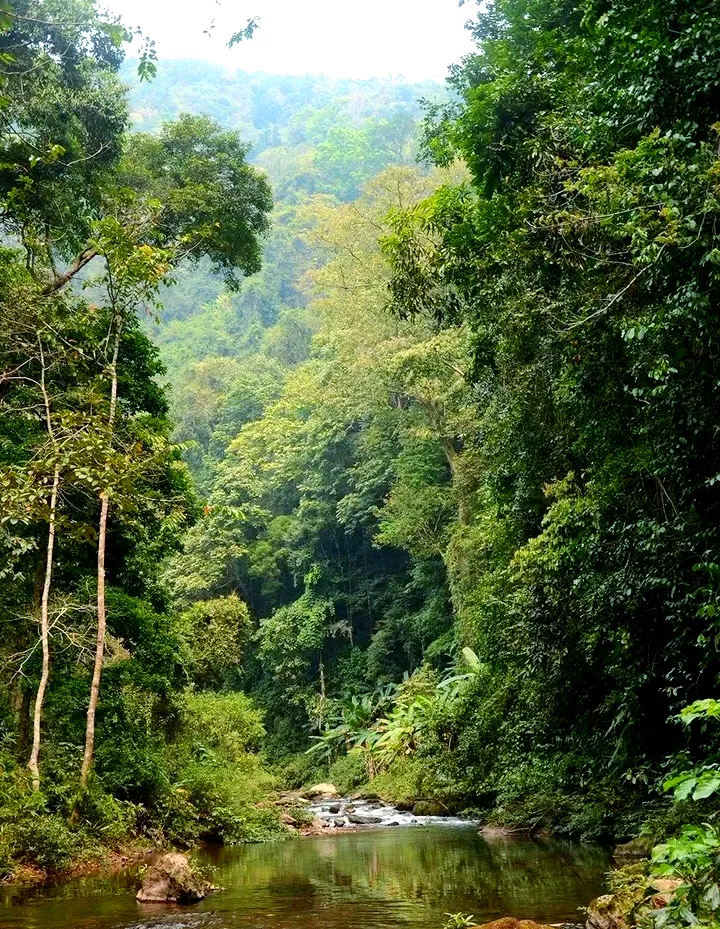
A small stream beside the tea forest
Laosen's view: This cup of tea needs to be savored slowly
Despite all the problems I've mentioned, I'm still optimistic about the future of forest tea. The reason is simple: Truly good things won't be buried.
Nowadays, information is increasingly transparent, and tea enthusiasts' tasting skills are improving. If you put a real forest tea and a fake one side by side, someone in the know can tell the difference with one sip. Those who rely on fooling people to make quick money won't last long in an era of transparent information.
For tea enthusiasts, my advice is simple:
- Don't be greedy for bargains. Real forest tea has its cost floor; if the price is lower than that, don't even look at it.
- Find the right person. Finding a reliable channel and a reliable person is more effective than learning a bunch of identification knowledge yourself. The prerequisite is that you trust them.
- Trust your own palate. Whether tea is good or not, your taste buds won't lie to you. Don't just listen to stories; drink more, compare more, and gradually you'll develop your own judgment.
The more chaotic the market, the more you need to stay calm. Tea is something that can't be rushed.

Paragraph comments 0 · moderated
Comments 0 · moderated