
In previous articles, we discussed what truly constitutes forest tea and how to distinguish real from fake. Today, let's delve deeper: What exactly makes forest tea so good?
I've encountered many tea enthusiasts who buy forest tea, enjoy drinking it, but when asked what makes it good, they can't articulate it. That's not their fault; it's our fault as tea makers for not explaining it thoroughly. Today, Laosen will break it down clearly.
Dimension One: Ecology—Tea as a "Byproduct" Grown in the Forest
First, let's address the most common phrase: "Forest tea has good ecology." But what does "good ecology" actually mean?
Let me illustrate with an analogy. If you plant a tea tree on terraced land versus in a forest, it leads completely different lives.
Tea trees on terraced land are densely packed, exposed to direct sunlight, with soil turned over repeatedly. With a sprinkle of chemical fertilizer, they shoot up within three months. This is like pigs in a pig farm—fed on feed, raised in confinement, growing fast but lacking flavor.
Forest tea trees, on the other hand, have large trees overhead providing shade, with sunlight filtering through leaves as diffused light. Underfoot is a thick layer of humus—fallen leaves, moss, dead insects, bird droppings—all mixed together, slowly decomposing into natural fertilizer. Beside the tea trees grow ferns, orchids, and various unnamed weeds. They can't compete with the tea tree for nutrients but instead help protect the soil and water.
Tea trees grown in such an environment are not rushed; they grow slowly, sprouting only once or twice a year. What do they absorb? They absorb the essence of the entire forest—wildflower fragrance, fruity wood notes, earthy aroma—all infused into the leaves.
This is what I mean: Forest tea is not cultivated by humans; it grows incidentally in the forest.
Dimension Two: Tree Age—Don't Blindly Worship Age; Look at How Well the Tree Thrives
When it comes to forest tea, some ask: "How old is the tree?" As if older trees necessarily produce better tea.
This thinking is partly right, but not entirely.
Where it's right: Older tea trees have deeper root systems, can absorb more minerals, and indeed, the thickness and depth of the tea liquor differ. The truly top-tier forest teas I've tasted have all come from old trees.
Where it's not entirely right: Tea trees are like people—age alone isn't enough; you need to see how well they're thriving. Some ancient tea trees grow in ecologically damaged areas where surrounding trees have been cut down, leading to soil erosion. The lone old tree stands there, seemingly centuries old, but it's already declining, and the buds it produces lack vigor.
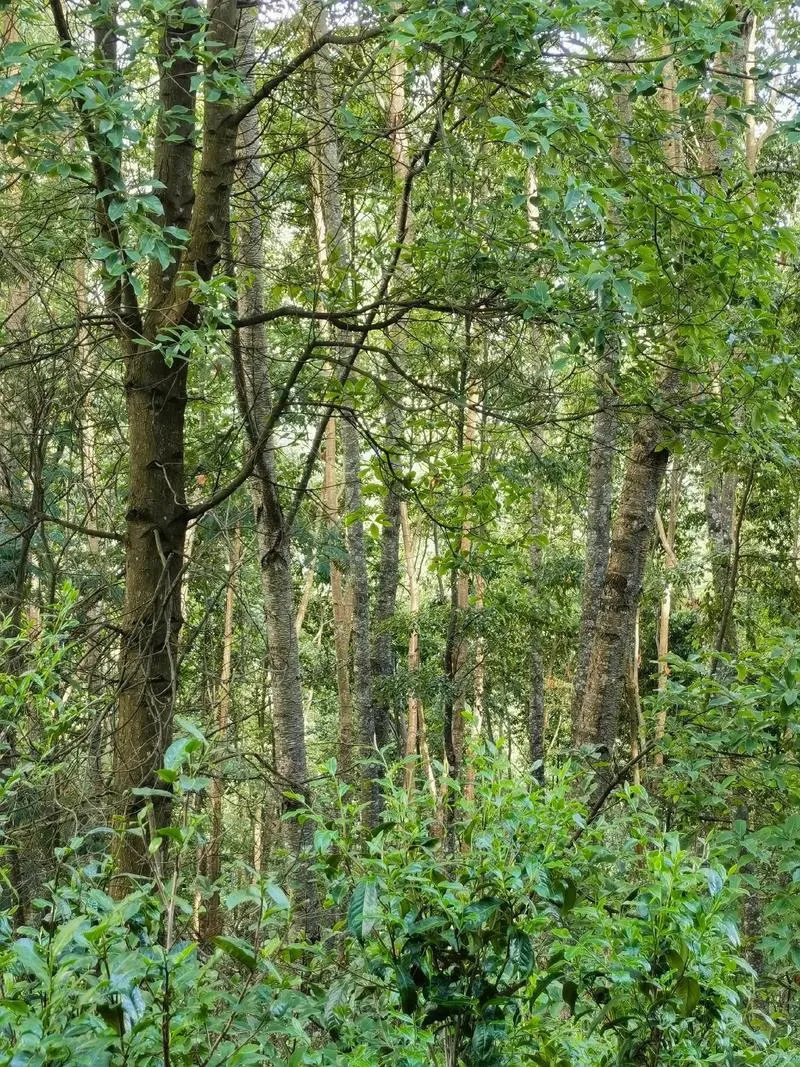
Ecological diversity of forest tea
Truly good forest tea depends not only on tree age but also on whether the entire ecosystem is alive. If the forest is alive, the tea tree is alive; if the forest is dead, the tea tree is just a shell.
Dimension Three: Taste—How to Detect the "Wildness" of Forest Tea
After discussing ecology and tree age, we must finally address the palate. The most distinctive feature of forest tea is what I often call 'mountain wildness and charm.'
This term sounds mystical, but let me break it down for you:
First is 'purity.' True forest tea, upon entry, gives an immediate sense of cleanliness—no off-flavors, no stale taste, no bland sweetness from chemical fertilizers. It's like the difference between mountain spring water and tap water; you can tell in one sip.
Second is 'thickness.' The tea liquor in the mouth isn't watery; it has substance. The tongue feels a full, rich tension, like sipping thick rice porridge. This thickness comes from the rich internal substances absorbed from deep soil layers.
Third is 'liveliness.' After swallowing, salivation comes quickly, and the returning sweetness is deep. It doesn't just end at the tip of the tongue; it's a sweetness that gradually rises from the root of the tongue and throat, with a hint of coolness, like holding a mint leaf. I call this 'throat charm.'
Fourth is 'longevity.' Good forest tea leaves a lingering aftertaste in the mouth for a long time. Even after drinking plain water, your mouth remains sweet and fragrant. This persistence is proof of rich internal quality.
Laosen's Honest Words
Forest tea—it's complex if you think about it, but simple too. The complexity lies in the ecological logic behind it; the simplicity is in the difference you can taste in one sip.
I don't advise you to just listen to what others say, nor to just look at the words on the packaging. If you have the chance, take a brew of true forest tea and a brew of ordinary tea, steep them simultaneously and taste them side by side—the comparison will make the difference clear.
Tea is something that can't deceive the palate.

Paragraph comments 0 · moderated
Comments 0 · moderated