
In the past two years, "forest tea" has become so popular that almost every tea table sees someone asking, "Is this forest tea?" That's how the market works—once a concept heats up, followers flock. After running tea mountains for over twenty years, I've seen "ancient tree tea" get ruined, and now it's forest tea's turn.
Today, I'm not selling tea, just sharing with you: What is real forest tea? What is just a wolf in sheep's clothing?
First, What Is Forest Tea?
Many people ask me, is forest tea the same as ancient tree tea? No. Ancient tree tea is about tree age, while forest tea is about the environment.
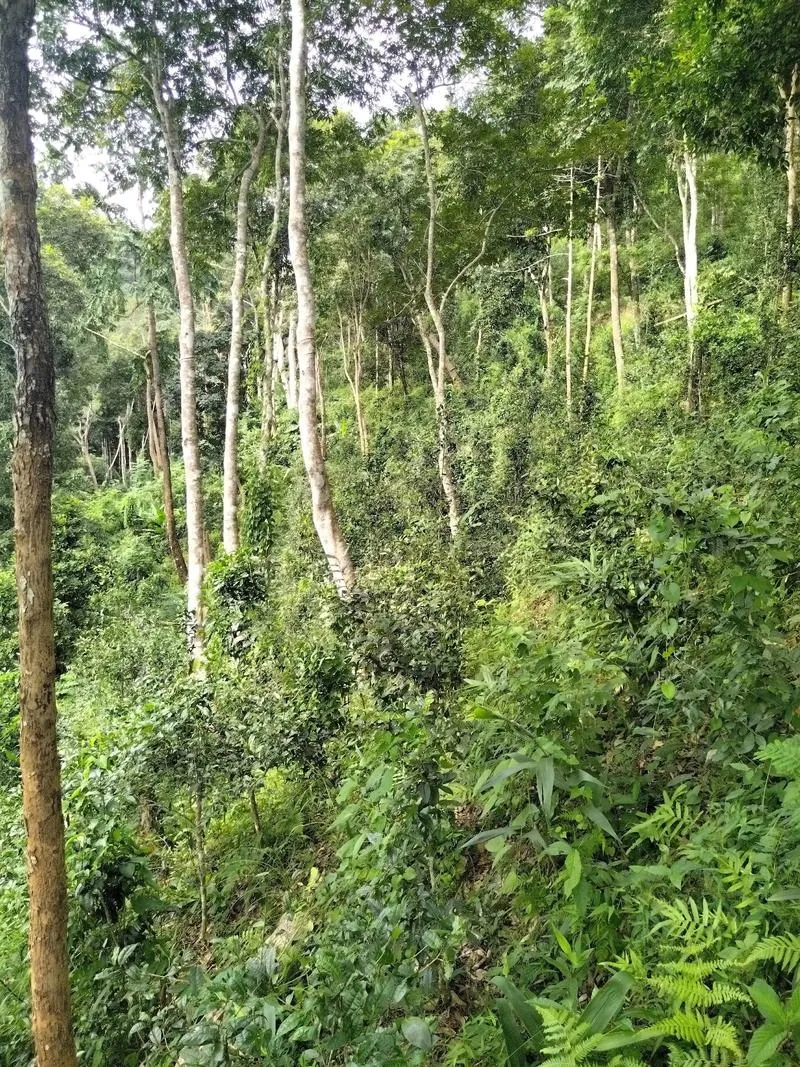
Small tree tea in the forest
Real forest tea must meet three strict criteria:
- Grows in a primeval forest—not by the village, not by the field, but a place where you lose phone signal and can't see the sky when you look up. Tea trees grow alongside big trees, shrubs, and flowers, each occupying its own layer without crowding each other.
- Minimal human intervention—no fertilizer, no pesticides, no weeding. Tea trees feed on humus soil and drink mountain spring water, surrounded by a natural ecological chain of insects eating insects and birds eating insects. In short, the tea grows naturally in the forest, not planted by humans.
- The variety must be a population group—that is, the old sexually propagated tree species with deep taproots that can absorb minerals from deep underground. Terrace tea roots are only 20-30 centimeters deep, absorbing only surface fertilizer and water. Can the taste be the same?
Now, About the "Fake Forest" on the Market
Let me tell you, at least half of the teas marketed as forest tea are fooling people. The three most common tricks are:
First: Terrace tea interplanted with shade trees. A terrace tea garden with a big tree planted every few meters dares to call itself "forest tea." That's as ridiculous as planting a tree in your courtyard and claiming you live in a forest. The tea tree is still the same, the soil is still the same, just with some shade overhead—how does that make it forest tea?
Second: Passing off ecological tea gardens as forest tea. Some tea gardens are indeed well-managed, no pesticides or fertilizers, but that's "organic tea garden," not forest tea. Organic is a standard achieved through artificial management; forest tea is a state of natural growth. They are two different things.
Third: Vague origin claims. When asked about the origin, they say "deep in a primeval forest," but when pressed for which forest or which mountain, they become evasive. Real forest tea has a clear origin—which state-owned forest, which mountain, even which plot—they can point it out to you.
Laosen Teaches You Three Tricks to See Through Fake at a Glance
With all that said, the most practical thing is to give you some usable tips. When you buy tea, follow these three rules to ask, look, and taste, and you'll surely pay less tuition.
First Trick: Check if the origin can be clearly stated.
Just ask the seller one question: "Where exactly is this tea from?" If they only say vague things like "deep in Yunnan's old mountains," put it down immediately. Real forest tea has a specific origin—like "Yiwu Guafengzhai Chawangshu" or "Yibang State-owned Forest, such-and-such plot." The more specific, the more credible.
Second Trick: Check if the tea soup has that "wild" flavor.
This relies on your palate. Real forest tea, upon entry, has a mountain wild charm—not just fragrance, but a full, clear, and vigorous sensation in the entire mouth. I call it "forest feel." Interplanted tea has thin soup and weak flavor, lacking that wildness.
Specifically, real forest tea causes rapid salivation under the tongue and on the cheeks, deep returning sweetness, and a throat resonance that reaches the chest. The fake ones are sweet, but not to that depth.
Third Trick: Check if the price is reasonable.
This is the most direct. Real forest tea has limited production, requires hours of mountain climbing to pick, and manual processing to bring back. It cannot be cheap. If you spend three to five hundred yuan on a cake of "forest ancient tree tea," don't doubt it—you've been taken for a ride. Things worth that price have their market value; the market isn't stupid.
Finally, a Few Words from the Heart
When I first started running tea mountains twenty years ago, no one mentioned "forest tea." Back then, good tea was just good tea; it was about the mountain, the tree age, and the tea maker's skill. Now there are more and more concepts, but we're getting further from the tea itself.
In the end, tea is for drinking, not for speculation. The goodness of forest tea lies in its clean growth in the forest, our clean processing into tea, and finally its clean arrival in your cup. Less tricks in between, more real stuff—that's what matters most.
If you have a "forest tea" you're unsure about, you can send me a picture, and Laosen will help you check it. I'll tell you everything I know about the tea mountains.

Paragraph comments 0 · moderated
Comments 0 · moderated