
I'm Laosen.
Last time I talked about myself. Today, let's get into the nitty-gritty of this 'forest tea.' In recent years, this term has become incredibly popular. In livestreams, nine out of ten sellers shout, 'My tea is pure forest tea,' and the cotton paper wrappers are printed with 'primitive,' 'wild-grown,' 'ecological.' But I tell you, eight out of ten are full of it.
Let me put it straight: Forest tea isn't written on paper; it's tasted in the mouth.
What exactly is forest tea?
Let's not get fancy. Simply put: This tea tree, from the moment its seed fell into the soil, has never been managed by humans.
It wasn't planted in a tea garden, wasn't dug and planted by humans, wasn't dwarfed, pruned, fertilized, sprayed, or tended by people. So how did it come to be? Blown by the wind, carried by birds, buried by squirrels and forgotten—in short, arranged by nature itself.
Then this tea tree grows alongside miscellaneous trees, wildflowers, ferns, and vines. It has to compete for sunlight, water, and root space. No one waters it; in drought years, it endures, driving its roots two meters deeper. No one loosens the soil; the humus layer accumulates year after year, soft like a sponge underfoot. No one removes pests; the forest has birds, spiders, and various natural predators, so humans need not worry. Survive if you can, die if you can't. In the forest, there's no 'guaranteed survival.'
A tea tree that survives in such an environment—you don't need to check its age; just look at its appearance: thick trunk, branches covered with moss, lichen, and even parasitic dendrobium, bark as rugged as crocodile skin. This isn't something age can fake; it's carved by time, cut by cut.
What we commonly call 'ancient tree tea' generally refers to cultivated tea trees of sufficient age, planted near villages or in tea gardens. Though old, they have been managed—pruned after harvest, irrigated in drought, and hoed when the soil compacts. Ancient tree tea is 'free-range,' while forest tea is 'wild-grown.' There's an essential difference.
Not to mention terrace tea—planted in neat rows like corn, sprayed, fertilized, dwarfed, densely planted, and harvested multiple times a year. I can tell from one sip: thin, watery, insipid, like plain water. Adding some flavoring can fool amateurs, but not the tongue.
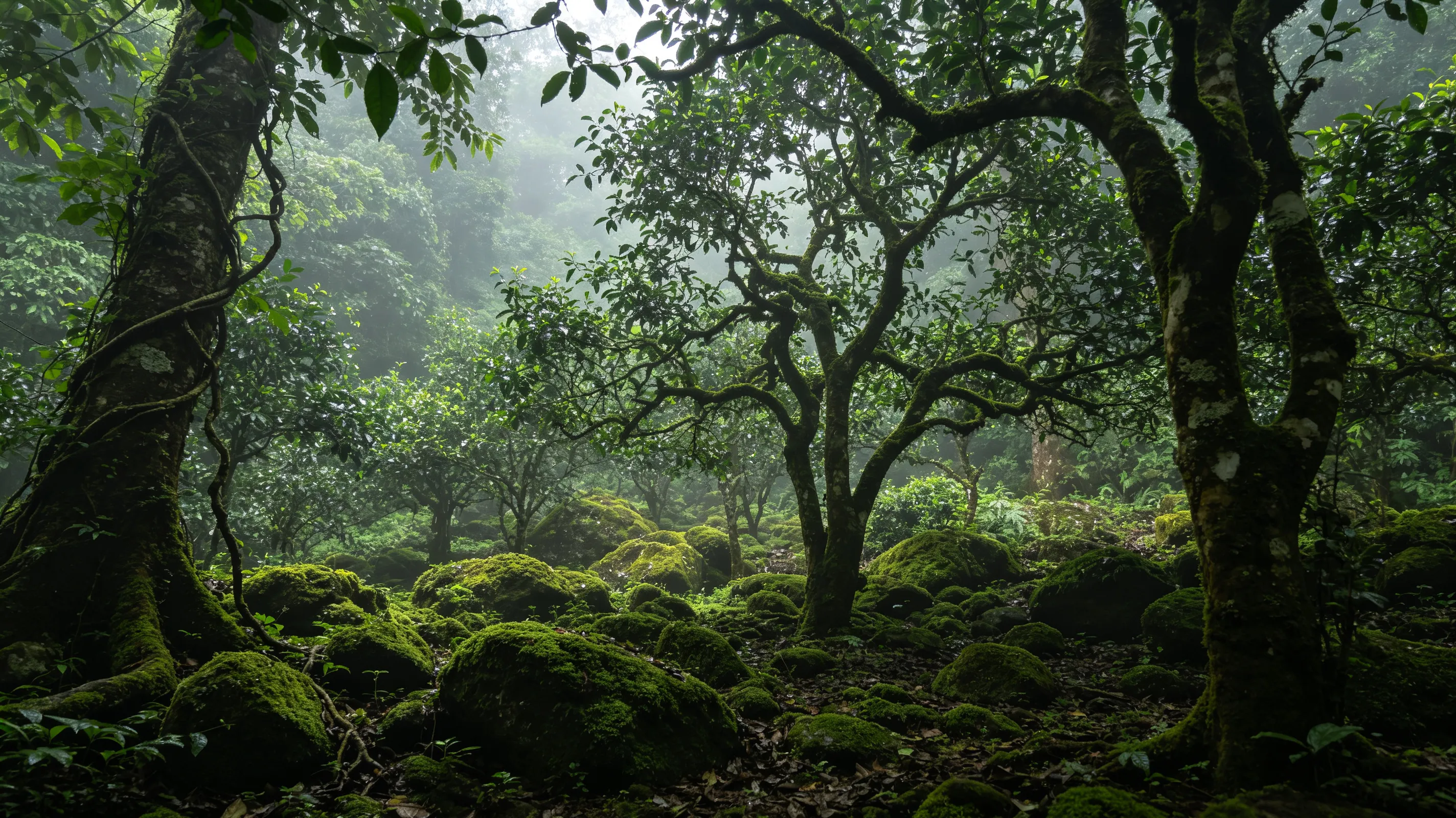
Image: Tea trees deep in the Xishuangbanna primeval forest, mixed with miscellaneous trees, showing no trace of human intervention
What makes forest tea good?
Let me be direct: Forest tea is good because it's 'not pretty.'
Don't laugh. Truly good forest tea often has twisted, uneven dry leaves, not plump buds, and sparse fuzz. Why? Because it grows in the shade, with insufficient light, resulting in thin leaves and slow growth. Conversely, those plump, fuzzy, white, and fat leaves are likely dwarfed, densely planted terrace tea, sun-exposed and fertilizer-boosted—pretty to look at but weak in flavor.
The goodness of forest tea is all in the liquor.
First, purity. One sip, and your entire mouth feels washed by mountain spring water. That pure sensation carries no off-flavors—no chemical greenness from fertilizer, no strange bitterness from pesticides, no raw stink from poor processing. It's just a clean breath of vegetation. After swallowing, your throat feels open, not tight or constricted.
Second, thickness. Not strength, but thickness. Strength means more substances in the water; thickness means the substances are weighty. Forest tea's mouthfeel has 'bones'; it feels heavy in the mouth, like a sip of rice soup, pressing on the tongue. This thickness comes from decades or centuries of slow accumulation of internal substances, not something the nutrients of a spring harvest can stack up.
Third, length. Salivation and sweet aftertaste—ordinary teas last three to five seconds, but forest tea can stretch to fifteen to twenty seconds. Moreover, that sweetness isn't cloying sugar-water; it's a cool, sweet moisture that slowly rises from under the tongue and deep in the throat, carrying an indescribable wildflower and woody aroma. After finishing a cup, ten minutes later when you swallow saliva, your mouth is still sweet. I call this 'the tea speaks for itself.'
What are the 'forest teas' on the market now?
To be honest, in the past two years, I've been asked by many tea friends to authenticate 'forest tea.' When I open the cotton paper, the leaves are tight, fine, and uniform, with silvery, plump buds, and a pungent honey aroma. I don't even need to brew it; I directly tell the tea friend: This tea hasn't even touched the edge of the forest.
Real forest tea, first look at appearance: loose, twisted leaves, dark green to black color, long stems, thin leaves, sparse fuzz. Ugly. But it's ugly with justification. Then look at the infused leaves: after brewing, the leaves vary in size, thickness, and color, with uneven serrations on the edges. Why? Because it's a sexually propagated population variety—each seed-grown tree is different, unlike asexual cuttings that replicate thousands of identical plants from one leaf.
Of course, looking isn't enough; ultimately, you must taste it. I tell tea friends the simplest method: Brew a tea you usually enjoy alongside the one claiming to be 'forest tea' in a head-to-head comparison. Same water temperature, same leaf amount, same steeping time. After drinking, you'll understand—if the so-called forest tea's mouthfeel isn't even as good as your daily tea, then don't believe a word.
Over the years, I've seen too many people—sellers dare to claim, buyers dare to believe. A piece of cotton paper can wrap any story: eight-hundred-year-old trees, thousand-year-old forests, descendants of some tea king... I tell you, Tea trees don't recognize stories; they only recognize soil, water, light, and wind. If you pee near it, it knows what you ate; do you think you can fool it with pretty words?
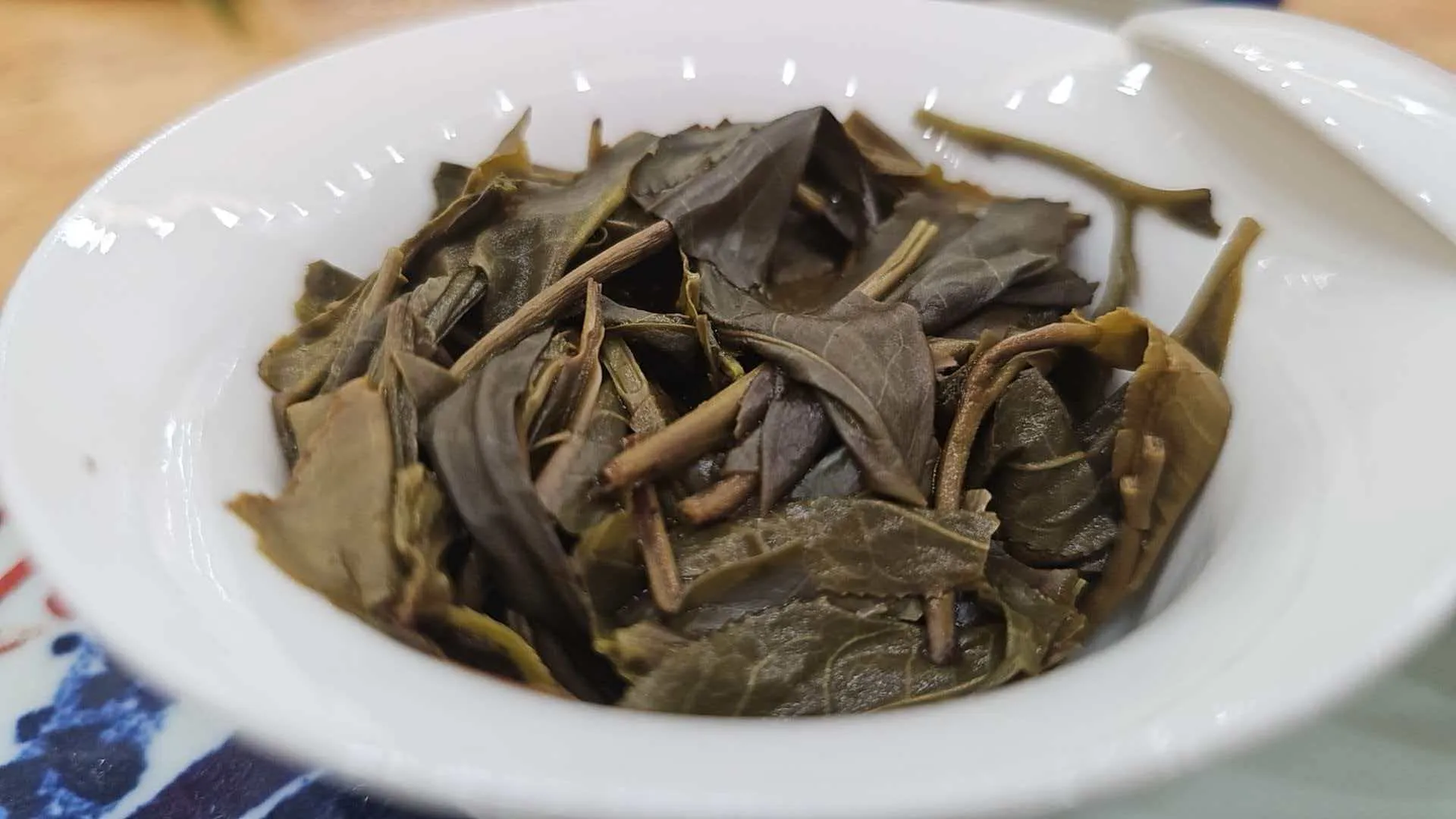
Image: Infused leaves of forest tea after brewing, varying in size and thickness, natural proof of a population variety
Laosen's honest words
Forest tea production is minuscule. In an entire primeval forest, only a few valleys and slopes have tea trees. A single tree yields only one or two kilograms of dried spring tea per year. The fresh leaves that the whole village can carry out in a day wouldn't fill half a day's sales for a city tea shop.
So don't expect to buy real forest tea for tens or hundreds of yuan. Not that expensive ones are necessarily genuine, but cheap ones are definitely fake. This principle is as certain as the sun rising in the east on the tea mountain.
The forest tea I make each year is limited. Regular tea friends come, each taking one or two kilograms, and it's gone. I don't do pre-sales, crowdfunding, or 'tea king tree' auctions—too tiring. When the tea is ready, I send a message; first come, first served.
I'm not saying this to get you to buy from me. I want to tell you: If you get good tea, savor it; if you can't, don't chase it desperately. In the end, tea should be true to your mouth and your wallet. Too many stories can go to your head, and when you're heady, you open your wallet, only to realize after—you drank a lonely cup.
Alright, that's it for today. I'm Laosen. See you next time.
Paragraph comments 0 · moderated
Comments 0 · moderated