
Today, let's talk about something that sounds technical but is actually closely related to the tea in your cup: the "origins" of tea trees—population varieties and clonal varieties.
You might have seen these two terms when buying tea, but you may not have fully understood them. Laosen will explain in plain language what the difference is and why true forest tea must be a population variety.
First, Clonal Varieties: The "Clones" of Tea Trees
Clonal varieties, simply put, are clones.
Scientists take a branch from a particularly good tea tree, insert it into the soil or graft it onto another tree, and the new tree that grows is genetically identical to the original. That's clonal propagation.
What are the advantages of clonal varieties? Stability. The tea produced is uniform in quality and high in yield, making it suitable for large-scale cultivation. Many of the terrace teas grown in tea gardens today are clonal varieties, such as "Yunkang 10" and "Zijuan."
What are the drawbacks? Genetic uniformity. In a clonal tea garden, all trees are cut from the same mold. This means they have the same resistance to pests and diseases—if one tree gets infected, the entire garden is vulnerable. Moreover, clonal tea trees have shallow root systems that don't penetrate deeply, so they can't absorb minerals from deeper soil layers.
Next, Population Varieties: The "Indigenous" Tea Trees
Population varieties are different. They reproduce sexually—tea trees flower, bees and butterflies help with pollination, and the resulting fruits fall to the ground and sprout new seedlings. Each tree is unique because its genes come from two different parent trees.
What are the advantages of population varieties? Genetic diversity. In a population variety tea garden, each tree has its own "personality"—some have larger leaves, some smaller; some sprout early, some late; some are more disease-resistant, some more cold-tolerant. They are like a "team" where each member has their own strengths, supporting each other.
Population variety tea trees have deep taproots that can penetrate several meters down, absorbing minerals and trace elements from deep soil. This is why tea from population varieties often has more body and depth in the cup compared to clonal varieties.
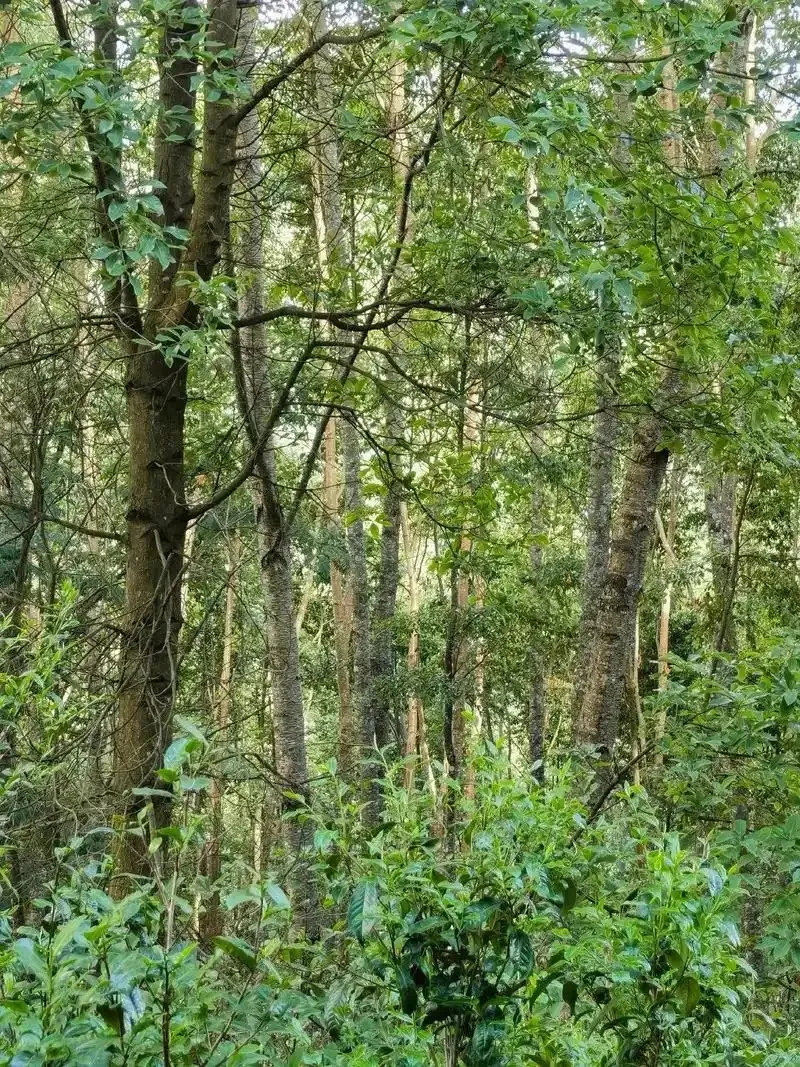
Forest Tea
Forest Tea Must Be a Population Variety
Now you should understand: true forest tea must be a population variety.
Why? Two reasons.
First, forest tea relies on natural ecology, not artificial management. In primeval forests, tea trees must survive on their own—resisting pests, diseases, cold, and flooding. Population varieties have genetic diversity, so there will always be some individuals that survive various adversities. Clonal varieties, with their uniform genetics, cannot withstand pests and diseases across the entire plantation.
Second, the flavor of forest tea comes from "mixed harvesting." In a true forest tea garden, tea trees grow mixed together; you can't just pick buds and leaves from a single tree. Tea pickers mix fresh leaves from various trees in the forest, and the resulting tea has a complete "forest flavor." Clonal tea has a single, uniform taste and cannot achieve that richness and complexity.
What to Look for When Buying Tea
After reading this, you can be more discerning when buying tea.
If a tea is labeled "population variety," it means the tea trees are traditional, natural, and diverse—that's a plus.
If a tea only says "ancient tree" but doesn't specify whether it's a population variety, you can ask—is it a population variety or a clonal variety? Some ancient tree gardens have been modified historically, with old trees cut down and clonal varieties planted. Such tea may have considerable tree age, but it's not a true "ancient tea tree."
Of course, not all population varieties produce good tea. Variety is just the foundation; you also need to consider the growing environment, tree age, and processing techniques. But one thing is certain: tea that isn't even a population variety can never be called forest tea.
Laosen's Final Words
The "origins" of tea trees determine the "depth" of the tea liquor. Population variety tea is like a band where each member has their own timbre, and together they create a complete symphony. Clonal tea is like a piano solo—pleasant to hear, but lacking richness and variation.
True forest tea must be a chorus of population varieties, not a solo of clonal varieties. This principle, you'll understand naturally after drinking more tea.

Paragraph comments 0 · moderated
Comments 0 · moderated