
In the previous articles, we talked about the varieties, ecology, and processing of forest tea. Today, let's discuss something that seems simple but actually has many intricacies: how to pick forest tea?
You might think picking tea is just plucking leaves, what's there to talk about? Laosen tells you, there's a lot of finesse involved. When to pick, which flush to pick, how long the bud and leaves should be, and how to pick without harming the tree—each of these directly affects the taste of the tea in your cup.
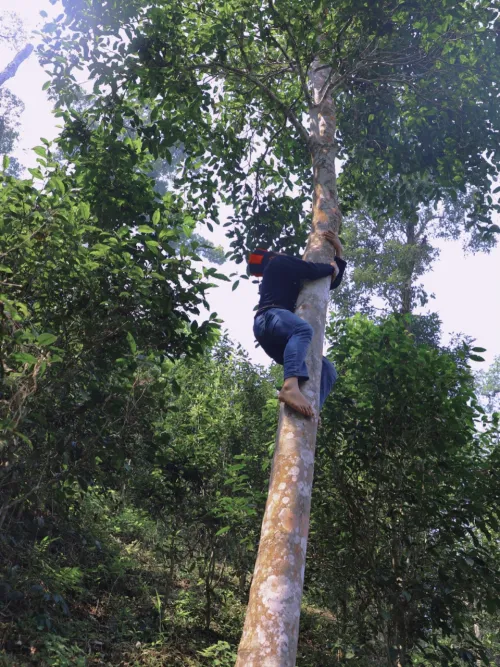
Picking ancient tall trees in the forest
First, the Season: Spring Tea is the "Headliner," but Earlier Isn't Always Better
How many seasons a year is forest tea picked? Most forest tea gardens only pick one spring season, at most adding an autumn season.
Why is spring tea the best? The tea tree accumulates nutrients all winter, and when temperatures rise in spring, nutrients are concentrated and sent to the buds and leaves. The fresh leaves picked at this time have the richest internal components—polyphenols, amino acids, and aromatic substances are at their highest all year. The brewed tea has excellent thickness, aroma, and charm.
But there's a misconception I need to address: Spring tea isn't necessarily better if picked earlier.
Some tea farmers rush to get early market produce and pick as soon as buds emerge. This "early spring tea" looks tender, but the internal quality hasn't fully developed; the tea liquor is thin, the aroma is fleeting, and it doesn't withstand multiple infusions. For truly good forest tea spring tea, you need to wait until the buds and leaves are about 70-80% mature—typically from after Qingming to around Guyu.
At this time, the buds and leaves have unfolded but not yet aged; the veins are clear, the flesh is thick, and when you pinch them, you feel a "meaty" texture. Fresh leaves picked this way produce tea with more punch.
Next, the Picking Method: Leave Leaves, Don't Harm the Tree
How is forest tea picked? It's not just about stripping the buds and leaves. The tea trees in forest gardens are precious, the primary principle is: don't harm the tea tree.
Specifically, how?
First, only pick one bud with two or three leaves. The ideal fresh leaves for forest tea are one bud with two leaves, or with three leaves. Picking the bud and leaves together balances the aroma and thickness of the tea liquor. If you only pick the bud, the tea is too delicate and doesn't withstand infusions; if you pick older leaves, the tea becomes coarse and astringent.
Second, leave a few leaves on each branch. When picking, you can't strip all the buds and leaves from a branch. You must leave the bottom few older leaves so the tree can continue photosynthesis and accumulate nutrients. This is "leaving rations" for the tea tree.
Third, use your fingers to "snap" rather than "pinch." Many people don't know this detail. Pinched wounds are prone to infection and heal slowly; snapped wounds are clean and heal quickly. A skilled picker uses a quick pinch-and-snap motion, clean and decisive, without dragging.
Fourth, don't step on the roots. Forest tea trees grow on slopes, and some pickers step on the soil at the base to reach higher buds. This compacts the soil, suffocating the roots. A good picker would rather climb extra steps than step on the roots.
Then, Autumn Tea: One Harvest a Year is the "Baseline"
Some forest tea gardens, after the spring harvest, will pick an autumn flush. But Laosen has to be honest: Autumn tea is not on the same level as spring tea.
What are the characteristics of autumn tea? High aroma and sweet liquor, but lacking the thickness and charm of spring tea. Because after the spring harvest depletes the tree, autumn nutrient accumulation isn't as sufficient. Autumn tea liquor is sweet on entry, but lacks the "skeleton"—it doesn't have the mellow depth and penetrating power of spring tea.
So my advice is: If you want to taste the "true essence" of forest tea, choose spring tea. Autumn tea can be an everyday drink, and it's more affordable, but don't expect it to reach the heights of spring tea.
Finally: Picking Tea Can't Be Rushed
Nowadays, some places, in pursuit of yield, pick tea trees more and more aggressively each year. Spring, summer, autumn—the trees never rest. This kind of picking weakens the trees year after year, and the buds they produce become thinner and thinner.
In all my years making tea, I've stuck to one principle: only one spring harvest a year. After the spring harvest, let the trees rest quietly. When winter comes, the trees shed leaves, go dormant, accumulate nutrients, and sprout anew the next spring.
Tea trees are like people; they need rest. Trees that don't rest can't produce good tea leaves.
When you buy forest tea, you can ask: "How many flushes has this tea been picked?" If they say only one spring flush a year, the quality is guaranteed; if they say multiple flushes a year, you should think twice.
Good tea is "waited" for, not "stripped" out.
Paragraph comments 0 · moderated
Comments 0 · moderated