
Let me first answer the most frequently asked question: What exactly is the difference between terrace tea and forest tea?
My answer is often a bit disappointing: The difference isn't in the words on the package, but in how the tea trees are grown. Understanding this is more useful than memorizing any mountain name. Currently, many teas are labeled "ancient tree" or "wild," but some of them are actually terrace tea materials under a different name. To avoid wasting money, learn to distinguish them yourself first.
Terrace Tea Gardens: Managed High-Yield Fields
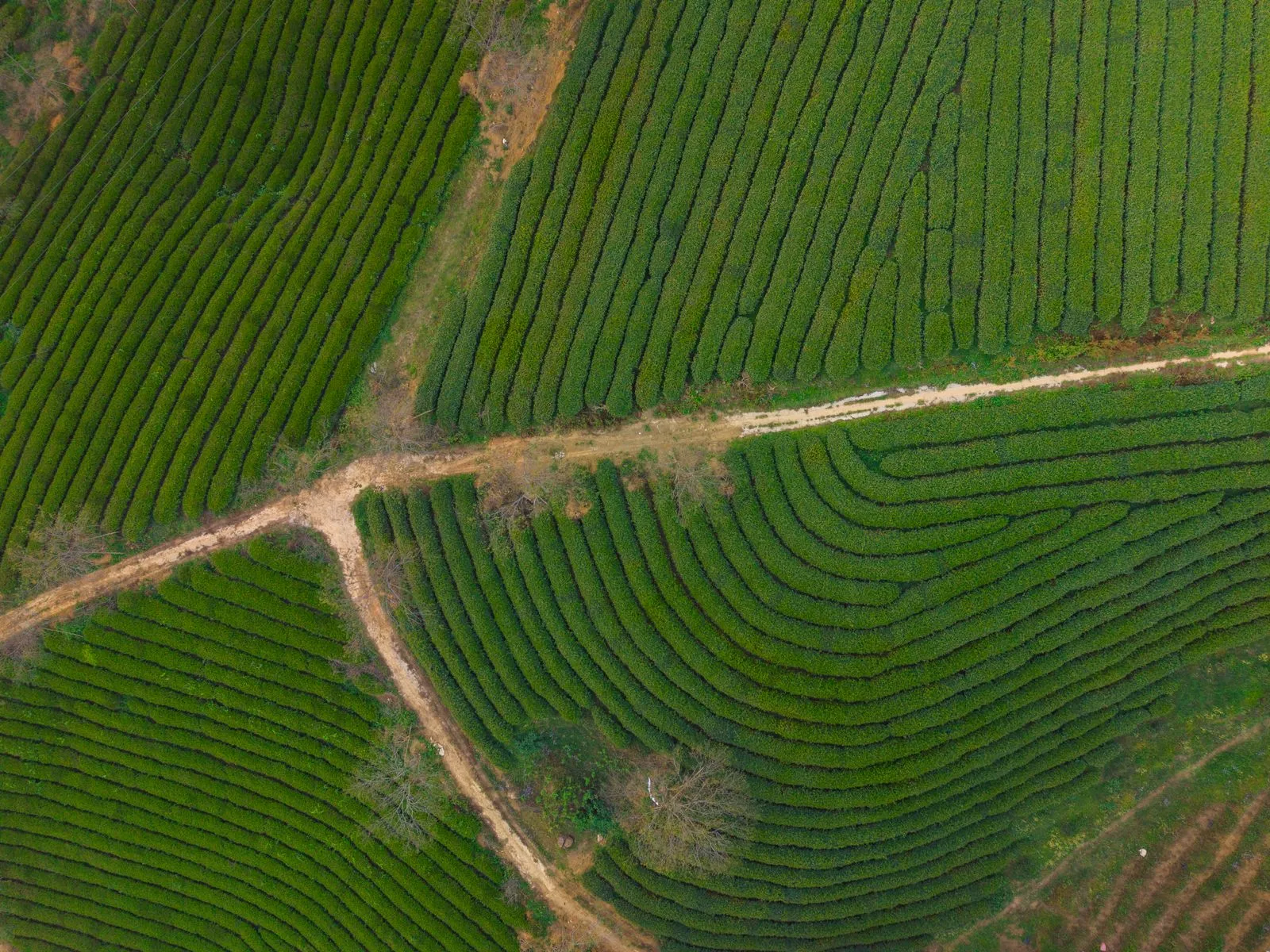
Terrace tea gardens treat tea trees as crops. They are cleared in large areas, densely planted in rows, and pruned into low shrubs for easy picking and management. To increase yield, fertilizers are applied, weeds are removed, and pesticides are used when necessary, with multiple harvests per year.
There's nothing wrong with this management; it ensures stable yields and low prices, making tea accessible to every household—it's the foundation of the market. But understand this: densely planted tea trees have shallow roots, and most nutrients are supplied artificially. They sprout quickly and are picked frequently, so the leaves don't have time to accumulate substances slowly before being harvested. This is reflected in the tea liquor: the aroma is direct, the flavor comes quickly, and the layers are relatively thin. This is its characteristic, not necessarily good or bad, but it does take a different path from forest tea.
Forest Tea: Trees That Grow Naturally in the Forest
Forest tea is different. The tea trees are not crowded together in rows but scattered in primary forests, surrounded by tall miscellaneous trees, vines, and various plants. They are shaded by canopy trees above, and beneath their feet are fallen leaves and decaying soil, with insects and birds coming and going, forming a self-sustaining cycle.
In such an environment, no one fertilizes them, and rarely does anyone prune them. Tea trees must compete with neighboring trees for sunlight and water, so their roots have to go deep to survive on their own. They sprout slowly and grow slowly, often yielding only one or two harvests per year. The result of this slowness is that the leaves accumulate substances fully and evenly. Whether the tree is old and whether the ecology is good will ultimately be reflected in the tea liquor—it can't be faked.
Distinguishing Through Three Things
You don't need to rely on the mystical to distinguish; just rely on tasting. My own habit is to look at three things:
First, examine the infused leaves. After steeping, the infused leaves of terrace tea are often thinner and more tender, with more stems and relatively uniform size; forest tea leaves are thicker, with clear veins, and after unfolding, they vary in size—a sign of natural growth without pruning. But don't take this as absolute; old terrace tea and young forest tea can be exceptions. The infused leaves are only a reference, not conclusive evidence.
Second, taste the mouthfeel. Terrace tea often has a pronounced aroma and direct entry, with the first two or three infusions being impressive, but then it fades quickly; forest tea liquor has more structure, a finer texture, bitterness that resolves, astringency that fades faster, and the middle infusions are more enduring than the first ones.
Third, savor the timing of the aftertaste. This is what I value most. The aftertaste of terrace tea often comes quickly and leaves quickly, like a gust of wind; forest tea's aftertaste may not be the fastest, but it comes steadily, moving slowly from the tongue surface to the back of the throat, with a lingering finish. A quick aftertaste isn't a skill; an aftertaste that lingers is.
By the way, this method can also be used when buying tea. If a tea marketed as "ancient tree" or "single trunk" has thin and tender leaves, a thin mouthfeel, and a fleeting aftertaste, you should question the high price; conversely, as long as the tea trees grow in a complete forest, even without a famous name, the tea liquor will speak for itself.
Don't Jump to Conclusions
Finally, let me say something practical: Tea is tasted, not judged by labels. In the same forest, trees on the sunny side and shady side taste different; even among teas called "forest tea," the quality varies depending on the ecology. To distinguish, the most clumsy but reliable way is to brew several teas side by side and compare them, from the infused leaves to the mouthfeel, and from the mouthfeel to the aftertaste. Once you've drunk enough, your body will naturally tell you the answer.
Paragraph comments 0 · moderated
Comments 0 · moderated